
The Modern Still Face: The Hidden Cost of Divided Attention

Screens, parenting, and emotional presence in autistic children: The modern still face
“Mummy, look at me.”
Few phrases capture the developmental needs of a child more clearly than this one. Children are not simply asking to be watched. They are asking for connection, orientation, emotional confirmation, and shared experience. They are asking another person to join them fully in the moment.
From infancy onward, children continuously reference caregivers in order to understand the world around them. In unfamiliar environments, stressful situations, moments of uncertainty, or emotionally overwhelming experiences, children instinctively look toward parents to determine how safe the environment is, how they should respond, and whether their nervous system can settle.
A child entering a loud shopping centre may immediately scan their parent’s face. A child hearing an unexpected sound may look toward the caregiver before deciding whether to panic. A child approaching unfamiliar people, a new classroom, or a socially demanding situation will often monitor the emotional reactions of the adults around them before deciding whether they themselves are safe.
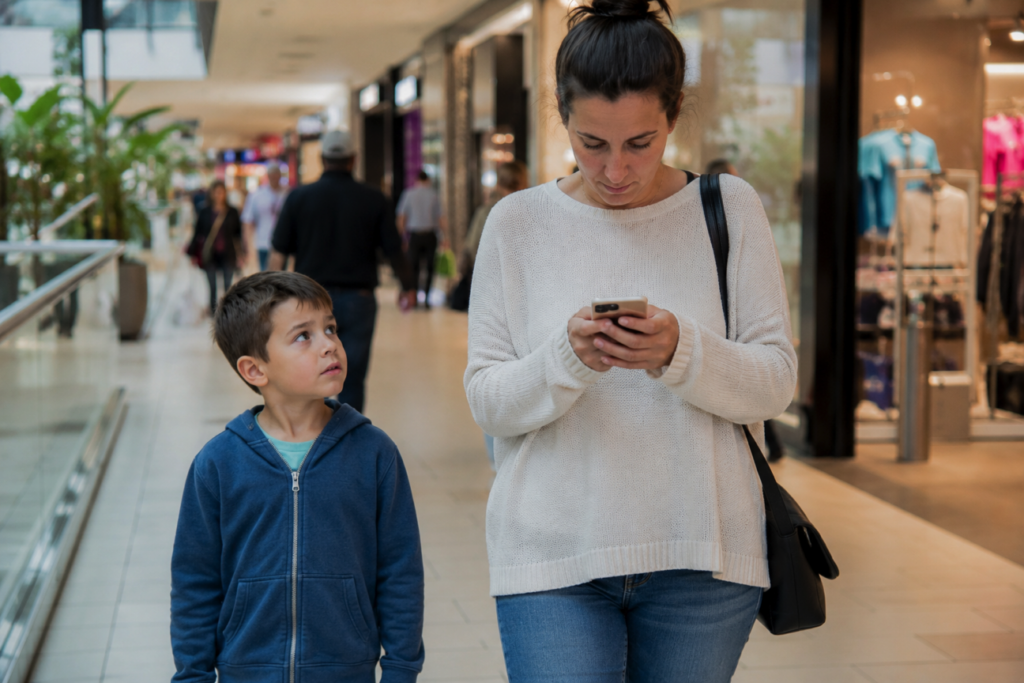
This process is known as social referencing, but at a deeper level it is really about nervous system orientation. Human beings regulate relationally. Long before children develop sophisticated language or emotional insight, their nervous systems are already gathering information from the faces, tone, posture, timing, and responsiveness of the people caring for them.
The still face experiment and emotional regulation
This is one of the reasons the famous “Still Face Experiment” by developmental psychologist Edward Tronick was so important. In the experiment, a caregiver initially interacts normally with their infant — smiling, responding, mirroring expression, and engaging emotionally. Then, suddenly, the caregiver becomes emotionally neutral and unresponsive while remaining physically present.
The infant’s reaction is immediate and striking. At first the baby attempts to pull the parent back into interaction through smiling, vocalising, pointing, and movement. As the emotional absence continues, distress escalates. The infant becomes dysregulated. Some eventually withdraw altogether.
The experiment revealed something profound about human development: children do not simply need supervision. They need emotional participation.
Facial expression, shared attention, responsiveness, eye contact, vocal tone, timing, and emotional reciprocity all help organise the developing nervous system. Emotional regulation is not taught primarily through instruction. It is transmitted through thousands of moments of co-regulation between nervous systems.
Smartphones and the modern “still face”
The modern world has created a version of the still face that is far subtler than the original experiment, but potentially far more chronic. Unlike the still face experiment, caregivers are not becoming completely expressionless. Instead, attention repeatedly disappears into devices. The child speaks while the parent scrolls. The child looks up and finds the caregiver’s gaze elsewhere. Moments of excitement are interrupted by “just a second.” Responses become delayed, fragmented, distracted, or emotionally thinner. Interaction loses rhythm.
Importantly, the issue is not occasional distraction. No parent can remain fully emotionally available every moment of every day, nor should they be expected to. Human relationships naturally contain moments of rupture, stress, fatigue, divided attention, and emotional absence.
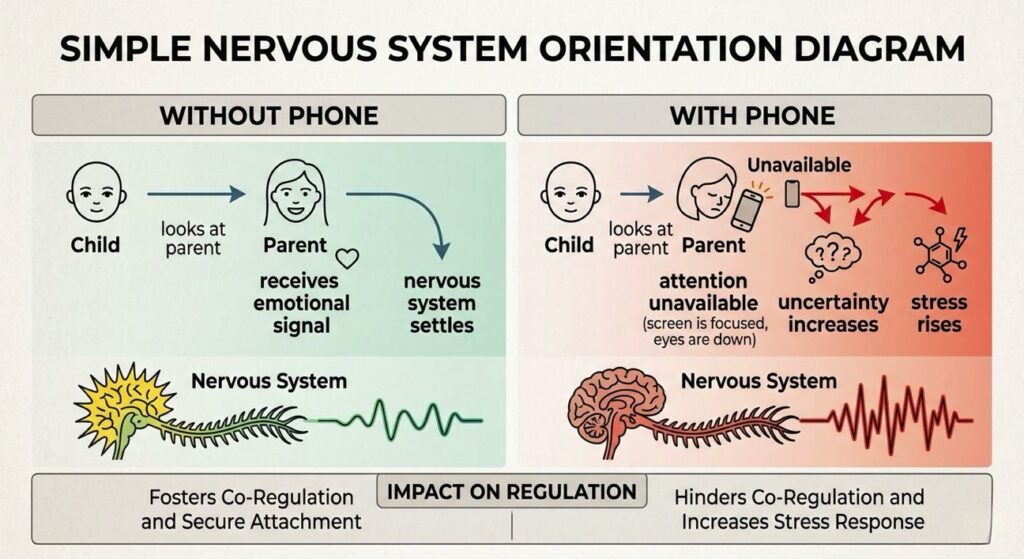
The concern is chronic attentional fragmentation.
Children experience this very differently from adults. Adults often conceptualise phones cognitively — as communication tools, work devices, entertainment, or harmless distraction. Children experience them relationally. To a child, repeated divided attention may not feel like “my parent is busy.” It may feel like intermittent emotional disappearance.
Why orientation matters for autistic children
This may become especially important when considering autistic children.
Many autistic children already experience the world as neurologically intense, unpredictable, or difficult to organise. Sensory information may arrive with greater intensity. Unfamiliar environments may create significant nervous system activation. Social communication may require more conscious processing. Emotional ambiguity may generate disproportionate stress.
In these moments, caregiver attunement often becomes an essential external regulating system.
An autistic child entering an unfamiliar environment may continuously monitor the caregiver for signs of safety and predictability. They may rely heavily on facial expression, emotional tone, timing of response, shared attention, and relational consistency in order to stabilise themselves internally. The caregiver effectively becomes an orienting anchor for the child’s nervous system.
But when caregiver attention repeatedly shifts into a screen, that orienting system may temporarily disappear.
The parent may still be physically present, yet neurologically elsewhere.
Eye contact decreases. Shared attention breaks. Emotional reciprocity weakens. Facial signalling changes. Timing becomes inconsistent. The rhythm of interaction becomes interrupted. For some autistic children, this may not simply register as distraction. It may feel disorganising at a nervous system level.
Importantly, this is not an argument that screens cause autism, nor is it an attempt to blame parents for autistic distress. Such narratives are simplistic and harmful. The issue is not causation, but regulation. Children who already struggle with uncertainty, sensory overload, or social interpretation may simply be more vulnerable to environments where emotional attunement becomes fragmented.
Screens, emotional distance, and passive observation
There is another layer to this discussion that is rarely explored: screens may not only divide attention, but alter the quality of emotional participation itself.
Research across multiple fields has shown that viewing experiences through screens can sometimes create emotional distance from what is being observed. War correspondents, emergency personnel reviewing footage, social media users repeatedly exposed to distressing content, and even photographers documenting traumatic events often describe a strange shift that occurs when life is experienced through a lens or screen. The screen creates a subtle psychological barrier between the observer and the experience itself. People can begin watching rather than fully participating.
Parenting is obviously not equivalent to these situations. However, the underlying mechanism may still matter. Repeatedly shifting between digital stimulation and relational interaction may gradually move a caregiver into a more observational state rather than a fully embodied relational one. The screen can function almost like an attentional filter between nervous systems. Instead of fully participating in the interaction, the caregiver may begin partially observing it from a psychological distance.
This distancing effect may also occur even when the caregiver appears highly engaged with the child. A parent recording a performance, documenting a milestone, or filming a child playing may still be experiencing the interaction through a screen-mediated observational state rather than through direct embodied participation. Although the parent may be physically attentive, part of their attention has shifted toward capturing, framing, monitoring, or viewing the moment rather than fully inhabiting it alongside the child.
This matters because co-regulation is deeply embodied. Children respond not only to words, but to micro-expressions, nervous system responsiveness, gaze, timing, posture, emotional synchrony, and the felt sense of another person being psychologically present with them. When screens repeatedly interrupt these processes, interactions may become less emotionally immersive and less synchronised at a nervous system level..
“Watch me”: behaviour as an attempt to restore connection
This may help explain why some children react so intensely to caregiver phone use. Many parents have experienced children repeatedly saying “watch me,” climbing onto them during screen use, interrupting conversations, physically pushing phones away, escalating behaviour, becoming louder, suddenly acting “silly,” or even throwing devices. These reactions are often interpreted as poor boundaries, oppositional behaviour, or attention-seeking. But from a nervous system perspective, many of these behaviours may actually represent attempts to restore relational connection.
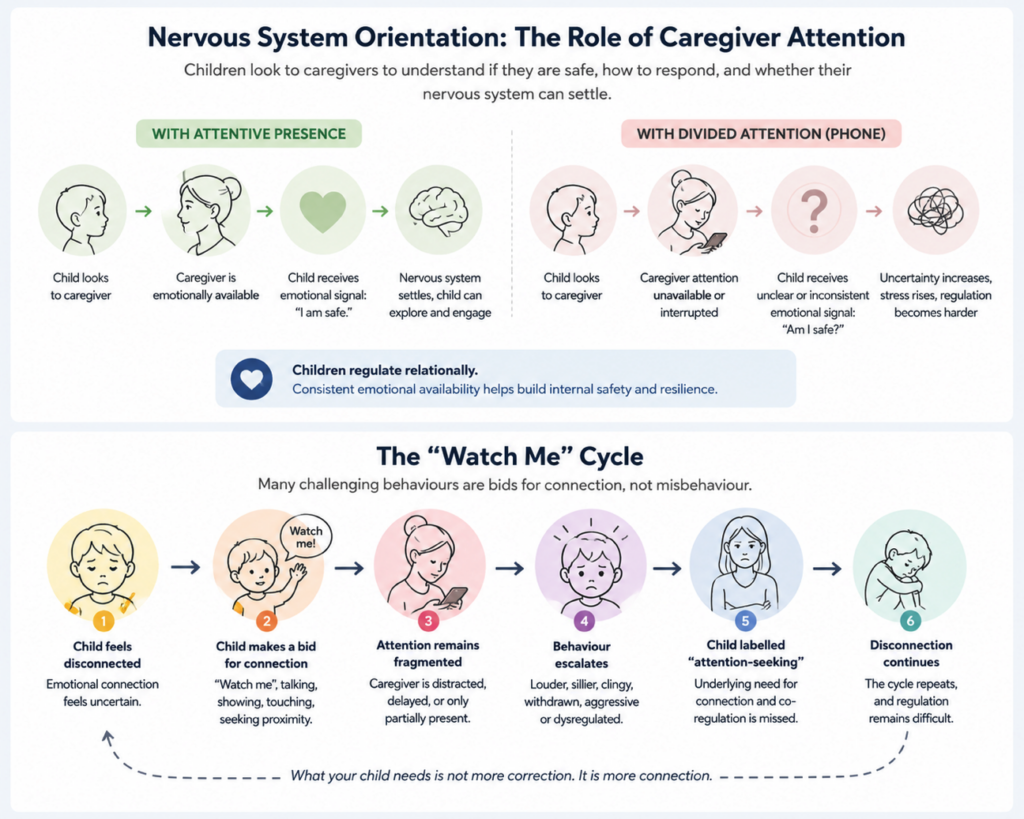
Behaviour is often communication before it is anything else.
A child who feels emotionally disconnected may escalate in order to pull the caregiver back into interaction. Another child may withdraw entirely. Some become hypervigilant to changes in emotional availability. Others seek stimulation elsewhere. Some autistic children may show increased repetitive behaviour, shutdown, sensory overwhelm, emotional escalation, clinginess, or distress in situations where relational orientation feels inconsistent.
These behaviours are not necessarily manipulative. They may reflect nervous systems attempting to restore predictability, connection, and regulation.
Why supporting parents matters too
At the same time, this conversation cannot ignore the reality that many caregivers are themselves profoundly dysregulated. Modern parenting often occurs under conditions of chronic overload, cognitive exhaustion, emotional depletion, financial stress, sensory saturation, and nervous system fatigue. Phones are therefore not simply distractions. For many adults, they have become fast-access regulation tools — sources of escape, stimulation, predictability, emotional numbing, decompression, and temporary relief.
This is partly why frameworks such as the RESTORE Framework™ matter. Parents cannot consistently provide co-regulation for children while operating from chronic nervous system overload themselves. Supporting caregiver regulation is not separate from supporting children; it is part of the same system. When adults develop healthier forms of restoration, structured rest, sensory recovery, emotional regulation, and nervous system support, emotional presence becomes more accessible.
The goal is therefore not perfection, nor is it moral panic about technology.
Children need presence, not perfection
Children do not need endlessly stimulating parents entertaining them every moment of the day. They do not need flawless emotional availability. Human relationships naturally contain rupture and repair. What matters most is whether the caregiver emotionally returns.
A parent looking up from a phone and saying, “Sorry, I missed that. Show me again,” may seem insignificant to an adult, yet to a child it communicates something profoundly important: connection can disappear and safely return.
Children do not simply need adults who supervise them.
They need nervous systems that orient toward them.
