How the environments we repeatedly experience become the environments we eventually carry within us
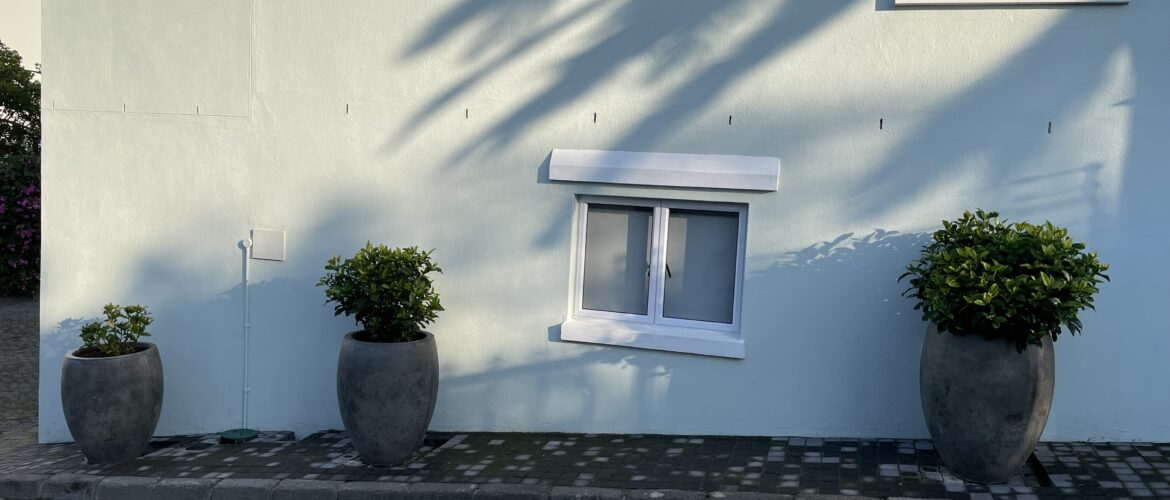
This photograph has become one of my favourite teaching tools, and the reason it works so well is that almost everyone who sees it draws the wrong conclusion.
Three plants. Noticeably different in size, density and health. The natural assumption — the one I have seen people make consistently — is that they must have been treated differently. One was perhaps planted earlier, or given richer soil, or watered more generously. Perhaps one was simply a stronger specimen to begin with, better equipped for growth from the outset.
None of that is true.
They were bought at the same time, planted on the same day, in identical pots, using the same soil. They receive the same care and the same water from the same people. There is only one difference between them, and it is not visible in the photograph. One receives slightly more sunlight than the others. Not dramatically more — on any given day you would barely notice. Yet that unremarkable difference does not stay unremarkable. It compounds. Month after month, year after year, a marginal advantage in light becomes a profound difference in outcome. The plants no longer look as though they shared the same beginning, even though they did.
I use this photograph because it illustrates, more precisely than most arguments I know, what two decades of working with neurodivergent people has taught me: that we consistently mistake the products of environment for the qualities of the person. And we do this, I think, because the environment that shaped them is no longer visible by the time we arrive.
The adults who come to see me almost always believe that the greatest obstacles in their lives exist within them. They describe themselves as lazy, inconsistent, overly emotional, disorganised, incapable of following through, or somehow less resilient than everyone around them. They have usually held these beliefs for a long time — long enough that the beliefs no longer feel like conclusions. They feel like facts.
What I have learnt is that these descriptions are rarely the whole story. The longer I sit with a person’s history, the less interested I become in asking what is wrong with them, and the more interested I become in asking what they have been growing in.
That question changes everything.
Inclusion is often discussed as though it is something we provide. We create accessible buildings, install ramps, introduce sensory rooms, allow flexible working, provide assistive technology. All of these things matter and many people depend on them. But if our understanding of inclusion ends there, we have missed something far more significant — and something far more honest about how human beings actually develop.
We do not develop within a single environment.
We develop within physical environments, which shape how our bodies and nervous systems interact with the world. We develop within cognitive environments, which determine whether curiosity is encouraged or quietly punished, whether mistakes become opportunities for learning or evidence of inadequacy. We develop within emotional environments, where children discover whether their feelings are welcomed, tolerated or treated as an inconvenience. And we develop within social environments, where they learn whether belonging requires authenticity or performance — whether they are accepted as they are, or only when they successfully conceal who they are.
These environments are not separate. They interact constantly, layering over one another throughout childhood and adolescence and into adulthood, each one contributing to the conditions in which a person is growing. And over time, something happens that I think we do not talk about nearly enough: the environments we repeatedly experience become the environments we eventually carry within us.
The child who repeatedly learns that their emotions are inconvenient often grows into an adult who no longer trusts their own emotional experience. The child who discovers that acceptance depends upon masking their differences may become an adult who has forgotten who they are underneath the performance. The child whose worth is consistently measured by achievement frequently becomes an adult who feels a guilt so habitual and so pervasive that they can no longer identify it as guilt — they simply cannot rest.
This is why I have never thought about inclusion as something that exists only in schools, workplaces or public spaces. Those environments matter enormously — but they matter most because of what they eventually become. The goal is not simply that someone feels included today. It is that they gradually develop an internal world in which they no longer have to exclude themselves tomorrow.
Looking at the photograph again, I notice something worth pausing on. No one would look at the smallest plant and accuse it of lacking motivation. We instinctively understand that its growth reflects its conditions. We do not hold it responsible for receiving less light. Yet when we encounter people whose development has been shaped by inadequate conditions, we reverse the logic entirely. We look at the outcomes and conclude something about the person rather than about the environment.
I want to tell you about someone I have worked with — I will call him Marco, though his story is a composite drawn from many people I have sat with over the years, all of whom would recognise something of themselves in it.
When Marco first came to see me he was in his early sixties. He had built what looked, from the outside, like an impressive life: multiple businesses, a wide professional network, a reputation for reliability and an almost legendary willingness to help anyone who asked. He was also exhausted in a way he could not adequately describe — unable to say no to a single request, operating in a state of such constant vigilance that rest had become something he could not access even when he stopped moving.
If you had searched online for how to support someone like Marco, you would have received sensible, well-intentioned suggestions about executive function, time management, task prioritisation and boundary-setting. And you would have missed him entirely.
Marco’s difficulty was not organisational. It was that his entire identity had been arranged, over six decades, around preventing failure — and beneath that, around preventing the specific kind of failure that had defined his earliest experiences: the failure of being seen as not enough. Every commitment he made was made because he could not tolerate the thought of disappointing someone. Every business he ran was an expression not of ambition but of terror. His nervous system had never, as far back as he could remember, been given permission to rest.
His internal dialogue — the voice he woke to every morning — did not accommodate him. It excluded him, systematically and without interruption, in a way no employer or institution ever formally had. Marco’s internal world had excluded him long before any workplace ever did.
That is an inclusion issue.
A tree that does not receive enough sunlight does not simply stop existing. It grows differently. Its roots spread in unexpected directions, searching for resources wherever they can be found. Its branches reach at unusual angles toward whatever light is available. Its entire structure reorganises itself around the missing resource — and over time, that reorganisation becomes so complete, so intrinsic to the tree’s form, that a person encountering it for the first time would simply call it the shape of the tree.
Humans do exactly the same thing, and I have stopped calling the results coping mechanisms. That framing implies a lesser response — a workaround, a temporary measure. I think of them instead as secondary ecosystems: complex, internally coherent structures that develop in response to an unmet developmental need and that, given enough time, come to look indistinguishable from personality.
Consider what a secondary ecosystem actually looks like in a person’s life.
The person who cannot say no has built an ecosystem — one organised around the belief that their value depends entirely on their usefulness to others. The person who overprepares for everything has built an ecosystem — one in which anticipating every possible outcome is the only available defence against a world that once felt dangerously unpredictable. The person who keeps fifteen alarms, three calendars and works until midnight has built an ecosystem — not because they are disorganised, but because the cost of a mistake was once, and perhaps still feels, catastrophic. The person who cannot identify what they need, because everyone else’s needs have always come first, has built an ecosystem — one in which self-erasure became the price of belonging.
These are not random habits or character flaws. They are coherent systems organised around a single missing developmental resource.
Many of the adults I work with have not built ineffective systems. Quite the opposite — they have built remarkably effective ones. But those systems were organised around surviving environments that excluded them, rather than around supporting the people they actually are. This is, I think, what burnout actually is in many cases — not the consequence of bad habits or insufficient discipline, but the eventual collapse of a system that was too effective for too long. The environment shaped the adaptation. The adaptation enabled survival. And survival, sustained over decades, became unsustainable. My work is rarely about dismantling those systems. They were intelligent responses to the environments in which they developed. My work is about helping people gradually build lives in which those systems are no longer necessary.
Marco’s secondary ecosystem was elaborate and, in its own way, extraordinarily intelligent. The relentless availability kept him valuable to others and therefore, he had learnt, safe. The inability to rest served a function — stillness had always felt dangerous because it left room for feelings he had spent a lifetime not having time to feel. People looked at his life and saw drive, capability and generosity. What I saw was what grows around a long-unmet need for permission — permission to exist without performing, to belong without earning it, to rest without first having justified the rest.
People do not only learn skills. They learn what they are allowed to become.
This is the idea that most fundamentally shapes how I understand my work — and why I believe inclusion is not merely a policy question but a developmental one.
Children are not simply learning mathematics. They are learning whether they are allowed to make mistakes. They are not simply learning language. They are learning whether their voice deserves to be heard. They are not simply learning social skills. They are learning whether authenticity is safe, or whether belonging requires them to become someone else entirely.
If a child is never permitted to take up space, they become an adult who apologises for existing. If a child is valued only when achieving, they become an adult who cannot rest. If a child learns that their emotions are an inconvenience to others, they become an adult who cannot readily identify what they feel. If a child must constantly monitor those around them in order to remain safe, they become an adult who experiences hypervigilance as simply being a responsible person.
None of those adults are broken. They are living inside environments that were brought indoors — internal landscapes shaped by thousands of experiences that, individually, seemed unremarkable, and that cumulatively became the architecture of a life.
By the time many people arrive in my practice, the secondary ecosystem has begun to fail. What clinicians call burnout is often, in my experience, something more structural: the collapse of an architecture that was never built to last indefinitely. The routines stop working not because the person has become less disciplined, but because the nervous system can no longer sustain the chronic effort of operating under conditions it was never designed to endure. The motivation disappears not because the person has stopped caring, but because the resources required simply to appear competent have been drawn down to nothing.
This moment is almost always misread — by the individual and by those around them — as evidence of a deeper flaw. The person who has managed a demanding career for fifteen years suddenly cannot complete a simple task and concludes they were always broken, just better at hiding it.
They were not. They had simply reached the limits of what adaptation could achieve. The architecture that had once protected them could no longer carry the weight placed upon it.
This is why early inclusion matters so profoundly — not as a kindness, but as an environmental condition that shapes the trajectory of an entire life, compounding in exactly the way that its absence compounds.
The adjustments that are sometimes dismissed as small are not small. A teacher who explains something differently. A parent who sits with a child’s distress rather than redirecting it. A workplace that allows someone to work in the way that actually suits their nervous system. These are small moments of sunlight. And whether or not they reach a person changes not just what that person can do, but what they come to believe they are permitted to be.
The photograph of those three plants reminds me of this every time I look at it. No one would blame the smallest plant for its size. No one would question its motivation or suggest it simply needs better habits. We understand, immediately and without argument, that it grew within the conditions available to it.
The question inclusion asks — the one I think matters most of all — is this: what conditions are we making available? And for those in whom inadequate conditions have already done their long, quiet work, a second question follows: how do we help someone recognise that the internal environment they built was adaptive rather than defective, and begin, carefully and without rushing, to cultivate a different one?
Because I do not think the purpose of inclusion is belonging. Belonging matters, but it is not the destination. The purpose of inclusion is participation — participation in our communities, in our relationships, in our work, in our families and, perhaps most importantly, participation in our own lives. That kind of participation becomes possible only when the environments we have repeatedly experienced have gradually become an internal environment spacious enough to include ourselves.
The plants were the same. The sunlight was not. And its effects, as with everything that compounds, only become fully visible when you step back far enough to see the whole life that grew beneath it.

Fantastic.
Thank you Janine!