
Blog
If My Child Knows What to Do, Why Don’t They Do It?
A companion piece for parents, teachers and therapists
Part 1: A Familiar Question
Parents ask it in different ways, but it is essentially always the same question.
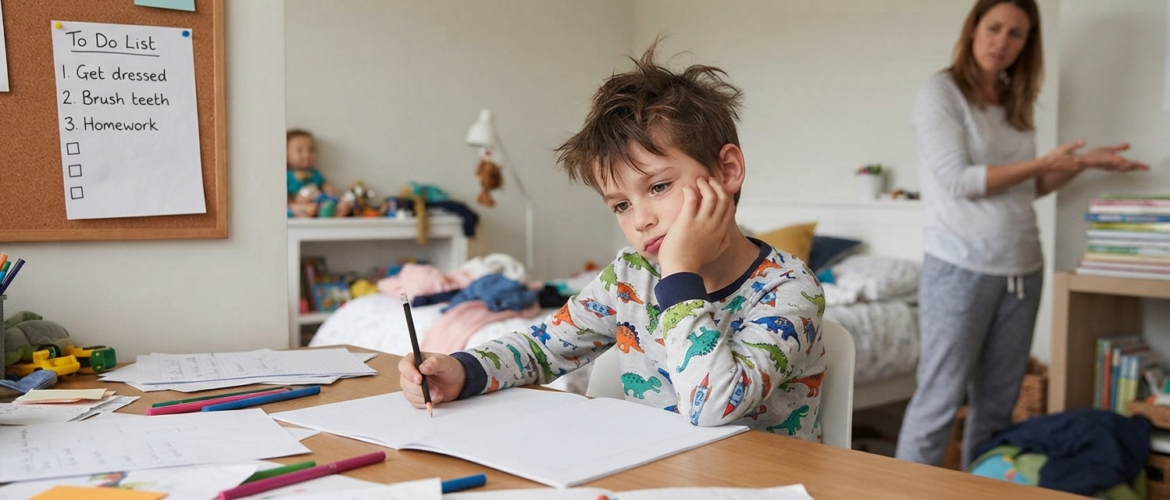
“He knows he needs to get dressed. Why is he still sitting there in his pyjamas?”
“She can tell me exactly what she’s meant to be doing for homework. She just won’t start it.”
“We’ve been through the morning routine a hundred times. He knows what comes next. So why do I have to say it a hundred and one?”
I have sat with this question many times, across clinics, classrooms and kitchen tables. These are not, on the whole, children who lack understanding. Many can describe their own routines in impressive detail: teeth before bed, reading logs signed, shoes before coats. Ask them, and they will tell you.
Ask them to do it, and something else happens entirely.
What has struck me most is who is asking this question. It is rarely a parent who has given up, or a teacher who has stopped caring. It is, more often, adults who have already tried a great deal: the reward chart, the differentiated task, the strategy rehearsed carefully in a therapy room that somehow never appears at home.
The child’s harshest critic is very often the child. Long before an adult says a word, many of these children have already concluded they are naughty, lazy, or simply “bad at trying.” Another instruction, another consequence or another reminder chart rarely changes that conclusion. Sometimes it only confirms it.
If children already understand what is expected of them, and many genuinely want to meet those expectations, why does the gap between knowing and doing remain so wide? The longer I sat with that question, the less interested I became in finding a cleverer reward system, and the more interested I became in understanding the gap itself.
Part 2: Knowing Is Not Doing
Underneath most of our approaches to children’s behaviour sits an assumption we rarely examine: that if a child knows what to do, they will, given enough reminders and enough motivation, eventually do it. Instructions, visual timetables, social stories and star charts are all built on this belief.
Yet the children I have worked with repeatedly show that this isn’t always true. Many know exactly what a good morning routine looks like. Some can coach a younger sibling through it with total confidence. They understand consequences, and can often explain, with striking insight, exactly why a particular behaviour tends to get them into trouble.
Knowledge is not the missing ingredient.
Knowledge is not the missing ingredient.
Russell Barkley, one of the leading researchers on ADHD, made an observation that has quietly reshaped how many clinicians think about children’s behaviour. He proposed that ADHD is not primarily a disorder of knowing what to do, but of doing what one knows (Barkley, 1997). Although Barkley was describing ADHD specifically, the distinction between knowing and doing helps explain a great deal of behaviour more broadly, whether or not a child meets criteria for any particular diagnosis.
The children who struggle to start their homework, who cannot seem to leave the house on time, or who fall apart during a simple transition, do not necessarily have a diagnosis at all. What they share is a familiar and frustrating experience: the gap between knowing what they are meant to do and consistently being able to do it.
If knowledge alone were enough, our current approach to teaching children about behaviour would already be remarkably effective. Yet many children already know a great deal of what would help them: that they should ask for a break before they melt down, that homework needs doing on Tuesday rather than Thursday at nine o’clock at night. Something else clearly influences whether a child’s inner understanding shifts into outer behaviour.
Part 3: Behaviour Is More Than a Decision
It is easy to assume that behaviour is simply a decision: the child knows what to do, chooses to do it, and then carries it out. When the expected behaviour does not follow, we often conclude that the child is being defiant, lazy, or simply not trying hard enough.
But not everything in a child’s life can be commanded into existence. A child cannot simply decide to fall asleep the moment the light goes off. Calm rarely appears on demand in the middle of a meltdown. And knowing that something needs to happen does not automatically make the brain and body ready to make it happen.
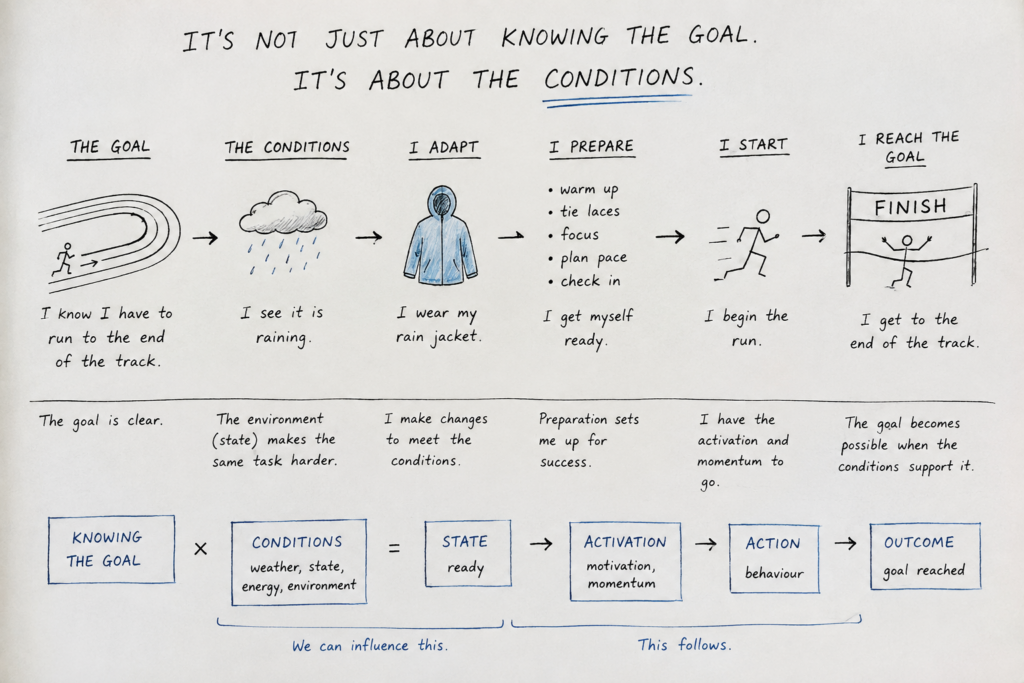
A farmer understands this instinctively. No farmer stands in a field demanding that a seed grow more quickly. The farmer prepares the conditions: the soil is cultivated, the seed is planted, water is provided, and the environment is protected. Growth is not something the farmer produces directly. It is something that emerges when the conditions are right.
Perhaps children’s behaviour works in much the same way.
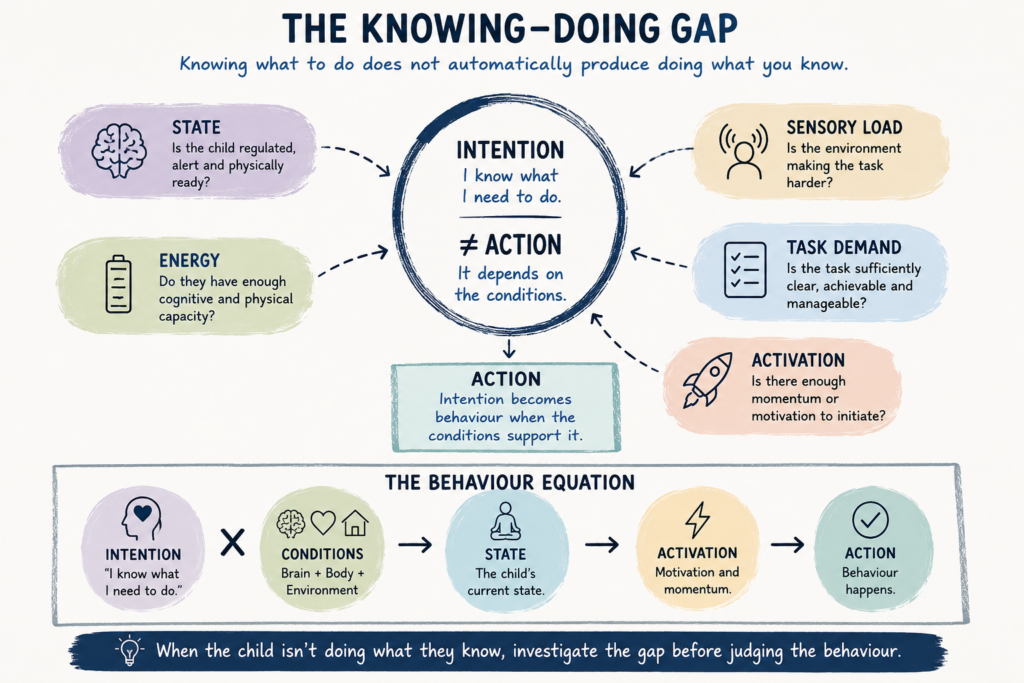
Behaviour does not happen in isolation. A child’s intention meets a particular internal and external state: tiredness, hunger, emotional arousal, sensory demands, noise, transitions, expectations and the demands of the task itself. The same child may dress independently on a Saturday morning and become distressed by the same task on a rushed Wednesday. The goal has not changed. What has changed is the state of the system attempting the task.
Behaviour is not simply something a child chooses in isolation.
Karl Friston’s Free Energy Principle describes the brain as part of a dynamic system continually adapting to changing conditions, both inside and outside the body (Friston, 2010). While this is not a theory of children’s behaviour specifically, it offers a useful way of thinking about behaviour as something that emerges through ongoing interaction between the brain, body and environment.
Once we see behaviour this way, the question changes. Instead of asking how to make a child behave better, we can begin asking what conditions make the desired behaviour more possible in the first place.
Part 4: Changing the State
If a child’s state influences their ability to act, an important possibility follows: we do not always need to change the task. Sometimes we need to change the child’s state before asking them to do it.
This also changes how we think about motivation. We often talk about motivation as though it is something a child either has or does not have. If they refuse to start their homework, we may tell them to find the motivation, remind them why the work matters, or explain what will happen if they do not do it.
But an unappealing or demanding task rarely becomes motivating simply because we continue explaining it.
Motivation may sometimes be generated elsewhere and then directed towards the task. A child who cannot face tidying their room may happily spend ten minutes organising football cards by team, colour and year. A child who resists a reading log may become completely absorbed in a comic. What looks like avoidance may sometimes be serving another function: the activity is helping the child settle, organise attention or reach a state in which action becomes easier.
Children often develop small, individual routines before attempting something difficult. They may line up their pencils, hum quietly, move around for a few minutes, listen to a particular song or follow the same route to their desk. These behaviours can look unnecessary from the outside, but they may be helping the child shift into a state that makes the next demand more manageable.
Dopamine is involved not only in reward but also in motivation and the willingness to engage cognitive effort (Salamone & Correa, 2012; Westbrook & Braver, 2016). This provides one possible mechanism for understanding why changing what happens immediately before a difficult task can sometimes change what happens next.
We often think of motivation as the walk to the starting line. Perhaps it is closer to the starting signal.
A timer, a favourite song, movement, a familiar routine or a parent sitting beside the child may make little difference when the child’s system is overwhelmed. But when the child is prepared and their state has shifted, the same cue may help initiate action.
Preparation comes first. The brain enters a different state. Motivation becomes the activation. Behaviour follows.
Preparation comes first. The brain enters a different state. Motivation becomes the activation. Behaviour follows.
This reframes motivation from something a child is simply expected to produce into something that can be influenced by the conditions around them. It also helps explain why telling a child to “just try harder” so rarely works. It treats motivation as a personal characteristic rather than recognising the interaction between the child’s brain, body and surroundings.
Part 5: Rethinking Behaviour Strategies
By this point, my view of the tools we typically reach for, reward charts, consequences, behaviour contracts, gentle reminders, had changed considerably. I no longer saw these as the missing ingredient that generates motivation from nothing. Instead, I began to see them as one of many influences that shape the conditions from which a child’s motivation and behaviour emerge.
This explains why a sticker chart sometimes works remarkably well for a while, and at other times produces only temporary change. A clear routine, a consistent consequence or a warm reminder can provide structure, reduce uncertainty, and make a task feel less overwhelming, temporarily changing the child’s operating state. The behaviour becomes easier to produce, not because the child has become more disciplined, but because the system around them has become more supportive.
If the underlying conditions remain unchanged, however, the benefits often disappear the moment the chart comes down. This does not mean the strategies are wrong. It means they were never designed to do the whole job.
(This reminded me of a video I created 2 years ago, which does show what I believe about reward charts, and why effort should be praised as much as result! See below. Humour is involved!)
Rather than asking whether a child needs a firmer consequence, it may help to ask what the strategy is actually changing. The answer is rarely a child’s underlying motivation. More often, it is changing the conditions under which their behaviour occurs, and that is a perfectly valid thing for a strategy to do, provided it supports the right underlying conditions rather than being expected to overcome an unprepared system on its own.
If external strategies are only one influence on the system, the goal cannot simply be permanent reliance on charts and reminders from the adults around a child. Over time, the goal must be helping the child learn to recognise and shape the conditions that allow their own motivation and behaviour to emerge. That is where agency begins to grow.
Part 6: Building Agency
If encouraging methods and consequences are tools rather than the destination, what are we really trying to help a child achieve? I believe the answer is agency.
Agency in a child is often mistaken for complete independence, but the two are not the same thing. Children have always relied on relationships, families and teachers in order to thrive. Needing help from an adult does not mean a child lacks agency; agency is built through exactly this kind of supported practice, gradually, with adults stepping back as a child becomes more able to notice and shape their own conditions.
Agency is the growing ability to understand the conditions from which one’s own behaviour emerges, and to begin, in age-appropriate ways, intentionally shaping those conditions.
For a young child, this might look like learning that they concentrate better after a snack, or that a quiet corner helps them settle after a big feeling. For an older child, it might mean recognising that homework goes more smoothly straight after football practice than after a long day sitting still at school.
This is a different kind of responsibility than the one we often ask of children. Instead of repeatedly asking them to try harder, we begin asking, alongside them, how we might better prepare the conditions from which their behaviour emerges. We become curious about a child’s patterns rather than frustrated by them, and help them become curious about their own patterns too.
Agency is not about a child controlling everything, or managing alone. Illness, sensory overload, family stress and unexpected changes to routine will always affect how a child functions on a given day. But within those constraints, a child, with the right support, can often learn to shape enough of their internal and external environments to make successful action more likely.
Part 7: Hope
One of the most rewarding moments in this work is not when a child completes a difficult task. It is when they realise they can.
For many children, months or years of struggling to act despite good intentions gradually erode something deeper than confidence. They begin to question their own character, describing themselves, sometimes in words startling to hear from a small child, as naughty, stupid or lazy. Often, they reject themselves and others on principle before they believe anyone else will, because trying and failing hurts more than not trying at all.
When children, and the adults around them, come to understand that behaviour emerges from the interaction between inner and outer states, they often stop seeing every struggle as a personal failure. Parents, teachers and therapists begin experimenting together with routines and environments, and small successes begin to follow. Progress, however modest, gradually replaces self-doubt, not because it proves mornings will always be easy, but because it is evidence that change is possible.
Hope is often described as the starting point for change, but I have come to see it differently. More often, hope is the result of repeated experiences in which a child’s intention successfully becomes action. It grows as small successes accumulate, strengthening a child’s belief that change is possible, not because they have suddenly discovered greater willpower, but because they, and the adults supporting them, have learned to work with the system from which their behaviour emerges.
Understanding a child’s behaviour does more than help them act. It helps them believe that they can.
Part 8: What This Means for Parents, Teachers and Therapists
If this perspective is correct, it changes the questions we ask when a child’s behaviour becomes difficult.
Instead of asking, “Why won’t my child just do what they’re told?”, we might ask, “What conditions are making this difficult for them right now?” Instead of searching immediately for a firmer consequence, we might first consider the child’s inner and outer state: their tiredness, their hunger, the noise around them, the transition they have just come from. Instead of hoping another sticker chart will finally solve the problem, we might help the child prepare themselves before we ask them to prepare the task.
These questions do not remove a child’s personal responsibility, nor an adult’s responsibility to guide them. They encourage all of us to work with a child’s brain instead of continually expecting it to overcome unfavourable conditions through willpower alone.
Small adjustments often prove more valuable than increasingly ambitious behaviour plans, and more sustainable, because they fit the child rather than expecting the child to fit the strategy. Two children can share exactly the same goal and require entirely different conditions to get there.
Perhaps the greatest practical implication is this: a child’s behaviour becomes something to investigate rather than something to judge. When action is difficult, the question is no longer “What is wrong with them?” but “What is this behaviour telling us about the conditions that produced it?”
Behaviour becomes information rather than moral judgement.
Behaviour becomes information rather than moral judgement.
Part 9: Conclusion
This essay began with a familiar and deceptively simple question: if a child knows what to do, why don’t they do it?
Following that question leads us to reconsider several assumptions commonly made about children’s behaviour: that knowing leads to doing, that motivation must appear before action, that behaviour is largely a matter of willpower. Neither research nor everyday experience with real children consistently supports these beliefs.
Drawing together findings from neuroscience, psychology and behavioural science, it is more accurate to understand a child’s behaviour as an emergent property of a dynamic system (Barrett, 2017; Friston, 2010; Salamone & Correa, 2012; Westbrook & Braver, 2016): brain, body and environment interacting continuously to shape whether intention becomes action. Motivation, consequences and reminders still matter, but they are influences on that system rather than independent causes of behaviour.
This does not remove the effort involved in supporting a child through difficult behaviour. It changes where that effort is invested, away from repeatedly forcing compliance and towards shaping the conditions from which a child’s action emerges. The changes that follow are more likely to be sustained, because the underlying system itself has changed.
This is not offered as the final explanation of children’s behaviour. It is simply a different way of thinking about a question that troubles so many of the parents, teachers and therapists supporting children today.
Sometimes the most important breakthrough is not discovering a new answer. It is asking a better question.
Perhaps, instead of asking how we can make a child more motivated, more compliant or more disciplined, we should ask:
What conditions allow this particular child to reliably act on their own good intentions?
References (APA 7th)
Barkley, R. A. (1997). Behavioral inhibition, sustained attention, and executive functions: Constructing a unifying theory of ADHD. Psychological Bulletin, 121(1), 65–94.
Barrett, L. F. (2017). How Emotions Are Made: The Secret Life of the Brain. Houghton Mifflin Harcourt.
Friston, K. (2010). The free-energy principle: A unified brain theory? Nature Reviews Neuroscience, 11(2), 127–138.
Salamone, J. D., & Correa, M. (2012). The mysterious motivational functions of mesolimbic dopamine. Neuron, 76(3), 470–485.
Westbrook, A., & Braver, T. S. (2016). Dopamine does double duty in motivating cognitive effort. Neuron, 89(4), 695–710.
