Blog
You Don’t Need a Bulldozer to Plant a Daisy

Technology, handwriting and how children actually learn.
For years, education systems have embraced technology as the future of learning. Tablets replaced textbooks, keyboards replaced pencils, and classrooms increasingly became extensions of the digital world. The assumption was straightforward: if technology makes information more accessible, it must also make learning more effective. And let’s be honest, a laptop weighs a lot less than an encyclopaedia!

Yet Sweden is now investing in physical textbooks, reading and handwriting, following concerns about reading performance and the educational consequences of extensive digitalisation (Government of Sweden, 2024). This policy shift raises an important possibility:
we may have confused access to information with the ability to learn.
The neuroscience of handwriting: why your hand matters
Handwriting is not simply recording information. It is a complex learning activity involving fine motor control, visual processing, sensory feedback, motor planning, letter recognition, language processing and memory encoding.
A 2024 study by Van der Weel and Van der Meer used high-density EEG to compare handwriting, typing and drawing in university students. Handwriting produced more elaborate patterns of brain connectivity, including synchronisation in networks associated with memory formation and learning.
Importantly, the study measured brain activity rather than learning outcomes, and its participants were young adults rather than children. Nevertheless, it provides evidence that handwriting engages the brain differently from typing.
When writing by hand, the learner must actively construct letters and words through coordinated motor and sensory processes. This may encourage deeper engagement with information. (It also leaves a small bump on the middle finger: the writer’s badge of honour.)

In young children, writing letters by hand, rather than typing or tracing them, appears to strengthen letter recognition, possibly because producing a letter links its motor pattern to its visual form (Longcamp et al., 2005; James & Engelhardt, 2012).
I call this “active reproduction”.
Research comparing handwritten and typed notes has produced mixed findings. Although some studies suggest advantages for handwritten notes (Mueller & Oppenheimer, 2014), later replication attempts have challenged the claim that handwriting consistently produces superior conceptual understanding (Urry et al., 2021). The distinction between writing, processing information and actually learning it remains important.
The textbook versus the screen
A physical textbook offers a stable learning environment.
Its layout remains constant, allowing learners to physically revisit information, annotate passages and develop spatial familiarity with the material. Highlighters, coloured pens and sticky notes, anyone?

Research comparing paper and digital reading has found that comprehension can differ depending on the reading medium, text characteristics and reading conditions. Some studies favour paper, particularly under certain demanding reading conditions, although paper does not universally outperform digital reading (Li & Yan, 2024).
Research on young children’s storybook reading adds nuance: children generally demonstrate better comprehension with printed books than with digital books that simply replicate the print experience, although digital enhancements that support the storyline can improve comprehension (Furenes et al., 2021).
The issue is not that screens are inherently harmful. Screens can, however, introduce additional visual stimulation, attentional switching and cognitive demands that compete with the learning task.
When the learning environment itself competes for attention, the learner must work harder to remain focused on the content. (Read a related article here)
Cognitive offloading: supporting the brain or replacing it?
Technology increasingly allows us to offload cognitive processes. We use calendars to remember appointments, reminders to manage commitments and external systems to organise information.
This is not necessarily problematic. Cognitive offloading can reduce unnecessary working memory demands and improve functioning, particularly for people with ADHD or executive functioning difficulties.
The important distinction is between cognitive support and cognitive replacement.
- Cognitive support: External systems compensate for limitations, reduce unnecessary demands or improve access to learning and functioning.
- Cognitive replacement: Technology performs a process that the learner would otherwise need to practise, understand or develop, potentially reducing opportunities for that development.
A visual timetable can support a child’s ability to manage a school day without removing opportunities to understand routines and develop independence. A calculator can support mathematical problem-solving without eliminating the need to understand numerical relationships. Assistive technology can enable learners to access information while still engaging meaningfully with it.
The concern arises when technology bypasses the very cognitive processes that learning is intended to develop. Think of a biceps curl. The biceps does the lifting, helped by two other muscles and steadied by a dozen more. Let a machine lift the weight for you and none of them grow stronger.
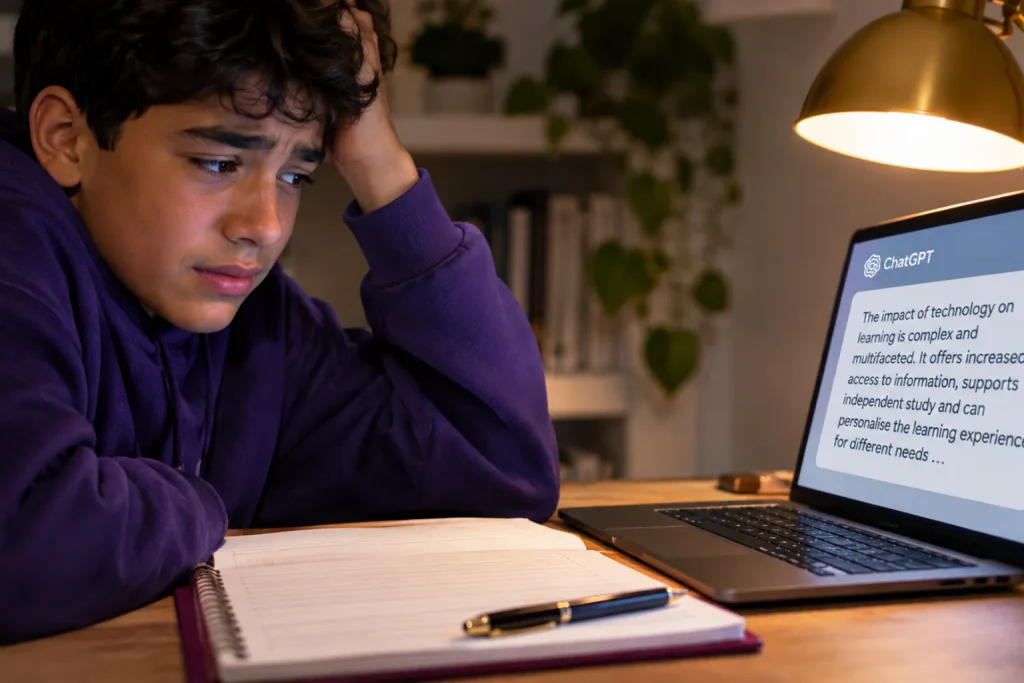
A child who uses speech-to-text because handwriting is physically difficult may access learning more effectively. A child who never practises handwriting, however, may miss opportunities to develop the motor and cognitive processes associated with that skill.
We should evaluate technology by the cognitive process it supports or displaces, not simply by whether it is digital.
Technology: a tool or a substitute?
The distinction we need to make is between technology as an accommodation and technology as the default learning environment.
For some children, technology is transformative. Text-to-speech, speech-to-text, alternative communication and accessible digital resources can remove barriers that would otherwise prevent learning.
For others, constant access to screens may introduce distractions, reduce opportunities to practise foundational skills or make sustained engagement with complex material more difficult.
These are not contradictory positions.
A tool should make a task more accessible or effective. It should not automatically replace the developmental process that enables a learner to perform that task independently. The scale of the tool matters too. You do not need a bulldozer to plant a daisy; a trowel does the job and leaves the soil intact.

The more a tool can do, the more of the learner’s work it can take over.
A spellchecker flags an error for the child to correct; an AI writing tool produces the sentence. The question is not only whether a tool helps, but whether it does more than the task requires.
This is particularly important during childhood, when foundational cognitive, motor and academic skills are still developing.
The value of productive difficulty
Learning is not always most effective when it feels easiest.
Bjork and Bjork’s concept of desirable difficulties describes how certain learning conditions that initially make performance more challenging can improve long-term retention and retrieval.
Practising recall, spacing learning and actively engaging with material can make learning feel harder while strengthening what is retained.
This does not mean difficulty is automatically beneficial. Unnecessary cognitive demands can obstruct learning, particularly for children who require additional support.
The challenge is to distinguish between demands that interfere with learning and those that contribute to its development.
A screen that distracts a child adds unnecessary demands. Practising handwriting, retrieving information from memory or solving a problem independently may introduce productive demands that support learning.
The answer is better judgement
The return to textbooks and handwriting does not need to be a rejection of technological progress. It may simply reflect a growing recognition that different tools serve different purposes.
Some learning is best supported by technology. Some requires physical practice, sustained attention, reading, writing and the deliberate effort to retrieve information from memory.
The challenge for education is to understand these distinctions rather than assuming that newer is necessarily better. Nor should we assume the opposite: that older is better.
The question is not whether children are using enough or too much technology. It is whether they are developing the skills, knowledge and cognitive capacities that will enable them to learn long after the technology has been switched off.
A book, after all, never needs charging.

Because the ultimate purpose of education is not simply to give children access to information. It is to develop their ability to think, understand, remember and learn.
References
Bjork, R. A., & Bjork, E. L. (2011). Making things hard on yourself, but in a good way: Creating desirable difficulties to enhance learning. In M. A. Gernsbacher, R. W. Pew, L. M. Hough, & J. R. Pomerantz (Eds.), Psychology and the Real World: Essays Illustrating Fundamental Contributions to Society (pp. 56–64). Worth Publishers.
Furenes, M. I., Kucirkova, N., & Bus, A. G. (2021). A comparison of children’s reading on paper versus screen: A meta-analysis. Review of Educational Research, 91(4), 483–517. https://doi.org/10.3102/0034654321998074
Government of Sweden. (2024). Government investing in more reading time and less screen time. https://www.government.se/articles/2024/02/government-investing-in-more-reading-time-and-less-screen-time/
Li, Y., & Yan, L. (2024). Which reading comprehension is better? A meta-analysis of the effect of paper versus digital reading in recent 20 years. Telematics and Informatics Reports, 14, 100142. https://doi.org/10.1016/j.teler.2024.100142
Mueller, P. A., & Oppenheimer, D. M. (2014). The pen is mightier than the keyboard: Advantages of longhand over laptop note taking. Psychological Science, 25(6), 1159–1168. https://doi.org/10.1177/0956797614524581
Urry, H. L., et al. (2021). Don’t ditch the laptop just yet: A direct replication of Mueller and Oppenheimer’s (2014) Study 1 plus mini meta-analyses across similar studies. Psychological Science, 32(3), 326–339. https://doi.org/10.1177/0956797620965541
Van der Weel, F. R. R., & Van der Meer, A. L. H. (2024). Handwriting but not typewriting leads to widespread brain connectivity: A high-density EEG study with implications for the classroom. Frontiers in Psychology, 14, 1219945. https://doi.org/10.3389/fpsyg.2023.1219945
James, K. H., & Engelhardt, L. (2012). The effects of handwriting experience on functional brain development in pre-literate children. Trends in Neuroscience and Education, 1(1), 32–42. https://doi.org/10.1016/j.tine.2012.08.001
Longcamp, M., Zerbato-Poudou, M.-T., & Velay, J.-L. (2005). The influence of writing practice on letter recognition in preschool children: A comparison between handwriting and typing. Acta Psychologica, 119(1), 67–79. https://doi.org/10.1016/j.actpsy.2004.10.019
